


Caring for Colorado’s 2026 Ballot Measure Positions
Election Day is November 3, and Colorado voters will decide ballot measures with significant implications for young people, families and communities acrossthe state.
Guided by our mission, vision and Board-approved position statements, Caring for Colorado reviewed each measure through the lens of its potential impact on the health, safety and well-being of Colorado’s young people—especially those facing the greatest barriers to opportunity, including communities of color and young people who are 2SLGBTQIA+, newcomers or immigrants, or who rely on public benefits and other safety-net supports.
Below is a summary of Caring for Colorado’s positions on eight 2026 statewide ballot measures and how each measure may affect young people, families, public systems, equity, and community well-being.
We encourage Coloradans to learn about the issues, make a plan to vote early, and share trusted, nonpartisan voting resources with their communities.
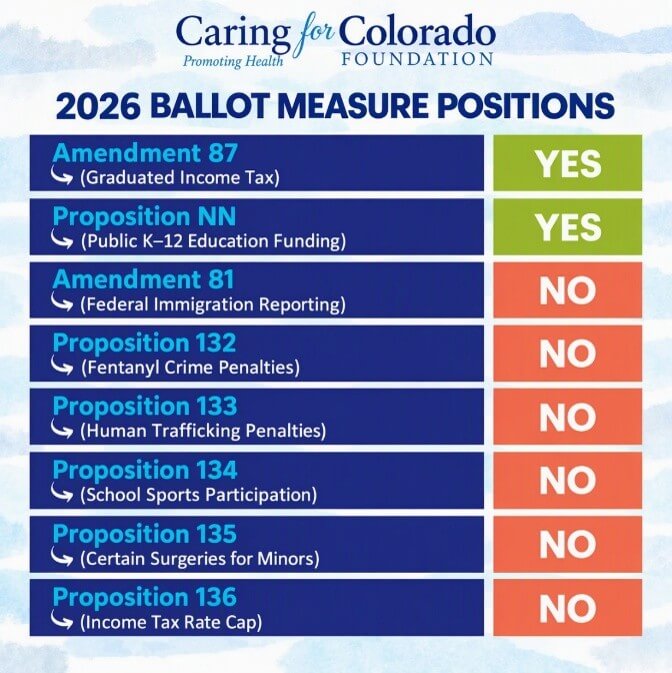
Caring for Colorado’s 2026 Positions
WE SUPPORT
SUPPORT — Amendment 87: Graduated Income Tax
Amendment 87 would create a graduated income tax that lowers taxes for most Coloradans while asking individuals and corporations earning more than $500,000 annually to contribute more. The measure would generate sustainable revenue for K–12 education, health care, early care and education, and other public systems that help young people and families thrive.
SUPPORT — Proposition NN: State Public K–12 Education Funding
Proposition NN would allow Colorado to retain and invest revenue above the TABOR cap in K–12 education and related programs for children, without raising taxes. These investments can strengthen schools and promote the health and well-being of young people across the state.
WE OPPOSE
OPPOSE — Amendment 81: Law Enforcement Reporting Requirements to Federal Authorities
Amendment 81 would require state and local law enforcement to report certain people to federal immigration authorities. It could increase racial profiling, weaken trust in public institutions and make families less likely to seek help or report crimes, with especially harmful consequences for young people in mixed-status households.
OPPOSE — Proposition 132: Penalties for Fentanyl Crimes
Proposition 132 would expand mandatory prison sentences for fentanyl-related offenses without investing in prevention, treatment, overdose reduction or recovery. Broad sentencing policies can sweep in people who did not know fentanyl was present, discourage calls for help during an overdose and divert public resources from services that support young people and communities.
OPPOSE — Proposition 133: Penalties for Human Trafficking of a Minor
Human trafficking of minors is already a serious crime in Colorado. Proposition 133 would replace the current felony sentence with life in prison without parole, a change advocates warn could treat some youth victims like perpetrators. Traffickers often target young people with trauma histories and coerce them into acts covered by the measure. With limited legal defenses and fear of prosecution, victims may be less likely to seek help or come forward, while the measure fails to address the conditions that make young people vulnerable to exploitation.
OPPOSE — Proposition 134: Male and Female Participation in School Sports
Proposition 134 would restrict transgender students’ participation in school sports. It would place government and schools in the middle of personal decisions and could undermine students’ privacy, safety and sense of belonging. All young people deserve safe, affirming environments where they can participate and thrive free from discrimination and stigma.
OPPOSE — Proposition 135: Prohibit Certain Surgeries on Minors
Proposition 135 would restrict certain forms of health care for transgender minors. Decisions about medically appropriate care should remain with young people, their families and qualified health care providers—not the government. The measure conflicts with our commitment to health equity and access to safe, affirming care.
OPPOSE — Proposition 136: Income Tax Rate Cap
Proposition 136 would cap individual and corporate income tax rates, further limiting Colorado’s ability to fund essential public services. At a time when the state faces significant budget pressures, this measure could deepen cuts to health care, education, public benefits and other supports that young people and families depend on.
Official information about Colorado’s 2026 ballot measures is available from the Colorado Secretary of State.
Questions about Voting? Need Help?
Call or text the nonpartisan Election Protection hotline:
- 866-OUR-VOTE (866-687-8683) — English
- 888-VE-Y-VOTA (888-839-8682) — Español
Required disclaimer: Just Vote Colorado Election Protection is a nonpartisan voter assistance project and is not affiliated with or promoting any party, candidate, or ballot issue, and is not affiliated with or responsible for the content of this piece.
Check your voter registration: Find my voter registration.
Key Colorado Election Dates
- October 2–9: County clerks mail ballots to active registered voters.
- October 12: Required ballot drop boxes are open.
- October 19: Required voter service and polling centers are open.
- October 26: Last day to register or update registration and still receive a ballot by mail; also the last suggested day to return a ballot by mail.
- October 27–November 3: Use a drop box, voter center, or vote in person instead of mailing your ballot.
- November 3: Election Day. Ballots must be received by 7 p.m.; postmarks do not count.